%20(6).png)
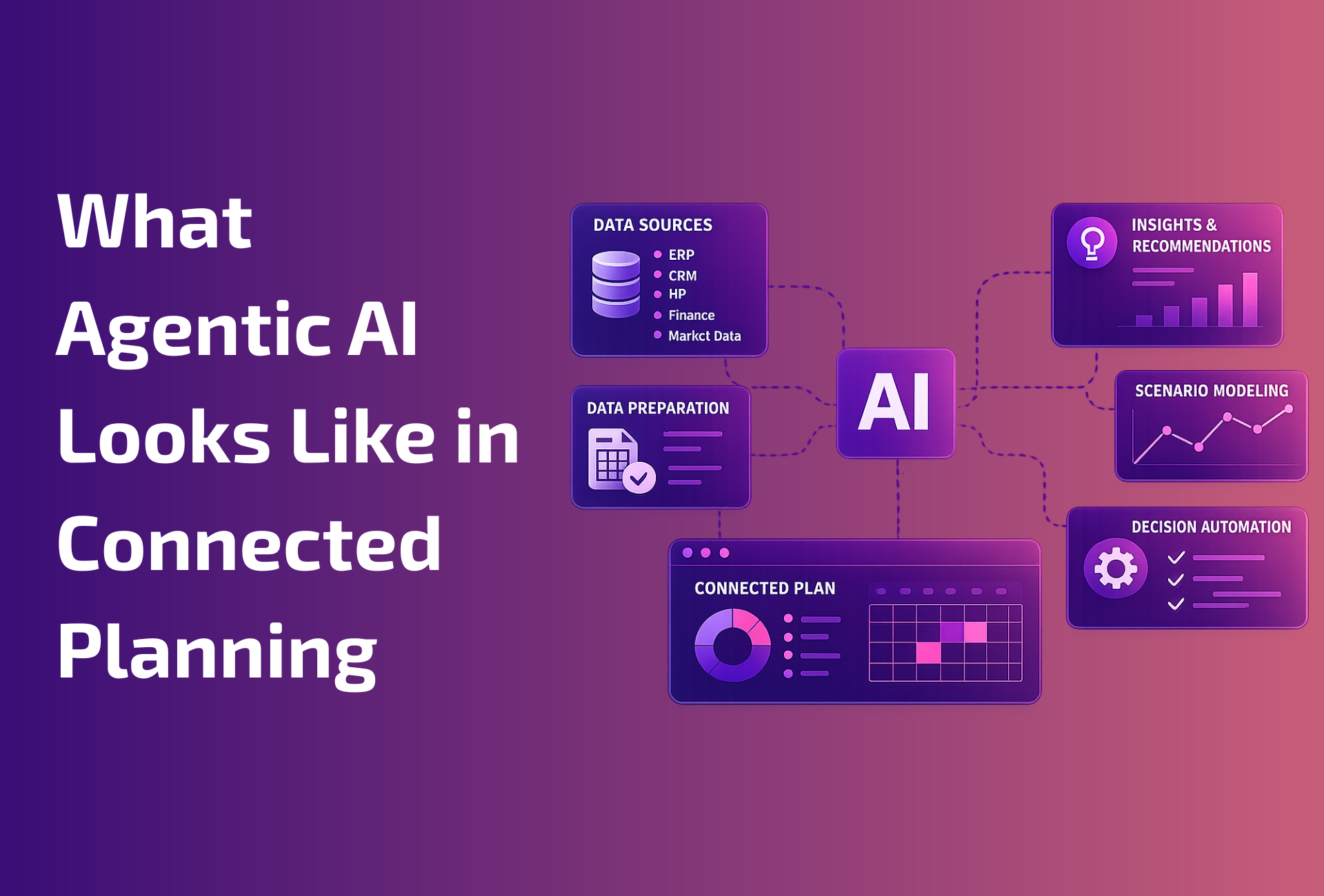
Most conversations about agentic AI focus on a single moment: an agent completes a task on its own. It builds a forecast, flags an anomaly, drafts a scenario. That moment is genuinely impressive, and it's also incomplete on its own.
A single agent doing one task well doesn't change how planning actually works. What changes planning is what happens when several agents operate across a connected environment, sharing the same data, the same context, and the same understanding of what just happened upstream, so that one agent's output becomes the next agent's starting point without a human manually carrying it between them.
That's the difference worth understanding: agentic AI as a feature versus agentic AI as an operating environment. The first is a demo. The second is what actually reshapes how a planning cycle runs.
An AI agent is only as capable as the environment it operates in. Give it a narrow, isolated task with clean inputs, and it performs that task well. Ask it to actually reason across a planning cycle, and it needs access to data and context from systems well beyond the one it lives in.
This is the part of agentic AI that gets skipped over in most product demos. An agent that can build a compelling scenario in a sandboxed environment isn't demonstrating what agentic AI does in production. It's demonstrating what it can do when someone has already handed it clean, connected data. The real work, and the real value, is in the connection itself.
Without it, an agent can still answer a question intelligently. It just can't act on the answer, because acting requires reaching into the systems where the actual planning work lives, and disconnected systems don't allow that reach.
It's worth being specific about what "isolated" looks like in practice, because most enterprises already have some version of it without realizing it's a limitation.
A forecasting tool with an AI feature that suggests likely revenue trends. A separate reporting tool with a chatbot that answers questions about last month's numbers. A third system with an AI-assisted anomaly detector watching a specific data feed. Each of these is genuinely useful. None of them talk to each other.
Isolated AI features
Smart in silos
Connected agentic workflow
Work flows automatically
In a genuinely connected planning environment, agentic AI operates across three layers that build on each other rather than sitting apart.
The data layer
Agents handle orchestration and validation continuously. Rather than waiting for a planner to notice a data quality issue, an agent monitors incoming data from source systems, applies validation rules, and resolves or flags exceptions before they ever reach a model. This is the foundation everything else depends on, because a connected environment is only as trustworthy as the data flowing through it.
The planning layer
Agents work with clean, validated data to build and adjust models, map planning processes, and collate inputs from across the organization. Because the data layer has already done the reconciliation work, the planning layer doesn't have to pause and manually verify inputs before building on them. A change in one part of the plan can propagate through connected models automatically, rather than triggering a separate manual rebuild.
The decision layer
Agents take validated plans and run them through scenario analysis, scoring outcomes against what the business actually prioritizes and surfacing the tradeoffs for a human to weigh in on. Because this layer has direct access to the plan the layer below just built, it isn't working from a static export or a data pull from three weeks ago. It's reasoning against the current state of the plan.
None of these three layers is remarkable in isolation. What makes the environment agentic, rather than just automated, is that each layer can act on the output of the one before it without a human manually bridging the gap.
It helps to see this as a sequence rather than a list of capabilities.
A cost input changes upstream — a supplier notifies procurement of a price increase, for example. In a connected agentic environment, that change doesn't wait for someone to notice it in a report.
Supplier price increase — connected agentic response
Change flows directly into the data layer, where it's validated against the source and reconciled with the current cost baseline
The planning layer picks it up automatically, adjusting the relevant driver-based model and flagging which parts of the plan are affected
The decision layer models the impact against a handful of scenarios, scores them against margin and cash targets, and prepares a recommendation with the reasoning visible and traceable
A human reviews that recommendation — not the raw cost change three systems ago, but a fully modeled, scored set of options ready for a decision
What used to take a week of manual data pulling, model rebuilding, and cross-team coordination happens as a connected sequence, with a person stepping in at exactly the point where judgment is actually needed.
That compression — from a change happening to a decision-ready recommendation — is what a connected agentic environment is actually for. It's not about removing people from planning. It's about only asking for their time at the point where their judgment adds real value.
There's a specific risk worth naming here, because it's easy to miss. Adding several capable AI agents to an enterprise without connecting them doesn't reduce silos. It can recreate them in a new, more sophisticated form.
A finance team with its own AI agent, an operations team with a different one, and a sales team with a third — each smart, each independently useful, and each working from its own version of the data — produces exactly the fragmentation connected planning was supposed to solve. The difference is that the fragmentation now moves faster and sounds more confident, because each isolated agent is capable enough to produce a plausible answer even when it's missing context another part of the business already has.
This is why connection has to be a deliberate architectural choice, not something enterprises assume happens automatically once enough AI features get added. An environment full of smart agents that don't share data or context isn't more advanced than a manual process. It's a manual process with more convincing-sounding outputs at each disconnected step.
This is the specific problem Krystal Sync AI is built to solve: not a single agentic feature, but the connected environment that lets agentic AI actually work across a full planning cycle.
Orchestrates and validates information from source systems continuously — so the foundation everything else depends on is always clean and trustworthy.
Builds and adjusts models on top of that validated data without requiring a manual handoff — so the planning layer never has to stop and re-verify inputs before building on them.
Runs scenarios and surfaces recommendations from the current, connected state of the plan — not a static snapshot. Each module is capable on its own. What makes the suite agentic in the fuller sense is that they're built to hand work to each other automatically, closing the gaps that usually require a person to bridge manually.
A single AI agent completing a task well is a capability. A connected environment where several agents build on each other's work — from raw data to a decision-ready recommendation — is a different kind of thing entirely.
That's the version of agentic AI actually worth evaluating: not how impressive any one agent looks in isolation, but how much manual coordination disappears when they're allowed to work together.
See connected agentic planning in action.
Book a demo and see how DataSync AI, PlanSync AI, and DecisionSync AI work as one connected agentic environment — not three separate features.
Book a Demo →

.png)

