%20(6).png)
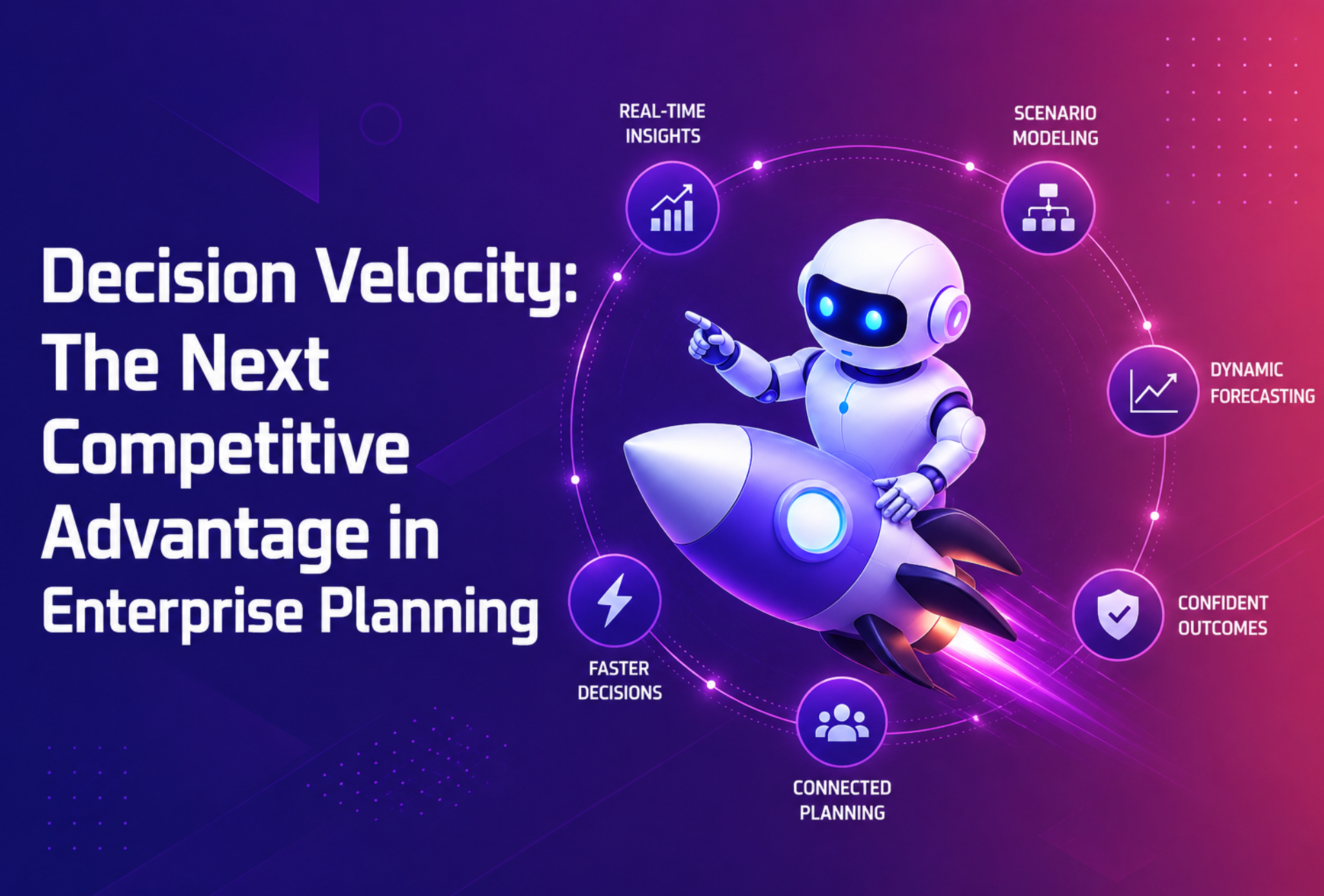
Enterprise planning has spent two decades optimising for efficiency: faster cycles, more automation, tighter forecast accuracy. These gains were real. But two companies can post nearly identical numbers on all three and still produce very different business outcomes.
The difference rarely shows up in the plan itself. It shows up in what happens after the plan meets reality.
This article introduces a different lens for planning maturity: Decision Velocity — the speed and confidence with which an organisation can detect change, evaluate options, align stakeholders, and act, without sacrificing decision quality.
Decision Velocity is not a metric to bolt onto an existing dashboard. It is a different way of thinking about what enterprise planning is actually for.
Efficiency metrics answer a narrow question: how quickly and cheaply can we produce a plan? They say little about whether the organisation acted well once conditions changed.
None of this makes efficiency metrics wrong. It makes them incomplete. They describe the plumbing of enterprise planning without describing what flows through it.
Decision Velocity is the sharper version of the question they are now asking.
Definition
Decision Velocity
The rate at which an organisation converts a signal — a shift in market, performance, risk, or opportunity — into a confident, executed decision, while preserving the quality of that decision.
Three parts of that definition matter:
It starts with signal detection, not planning. An organisation with a brilliant annual plan but poor signal detection will still be slow, because it won't know it needs to act until the signal has already become a crisis.
It is about confidence, not just speed. Decision Velocity is speed multiplied by justified confidence. A decision made in two days and reversed three times in the following month is not high velocity. It's a gamble dressed up as speed.
It treats execution as part of the decision. A decision that takes six weeks to reach the teams responsible for acting on it hasn't really been made quickly, from the business's perspective. Decision Velocity spans the full arc from signal to executed action.
The plan is not the deliverable. The decision is.
Three structural shifts explain why Decision Velocity matters more today than five years ago.
Decision Velocity is not one skill. It's the product of four — and any one of them can become the bottleneck.
Signal Detection
The ability to notice meaningful change early enough that a decision is still possible, rather than forced. A variance report generated three weeks after month-end is a historical record, not a signal.
Scenario Evaluation
Historically limited to two or three manually built scenarios, constrained by analyst bandwidth rather than by the actual complexity of the decision. Done well, scenario evaluation should be limited by the business question, not by available hours.
Stakeholder Alignment
A decision only exists operationally once the people responsible for acting on it understand it and know what it means for their area. This is where organisations quietly lose the most time: a plan approved in a finance committee that takes weeks to reach operations.
Execution Confidence
Teams execute cautiously when they can't see the reasoning behind a decision. Traceable decisions — where the logic and assumptions are visible — tend to get executed with more conviction than opaque ones.
An organisation is only as fast as its weakest capability. Heavy investment in scenario modelling means little if stakeholder alignment is still entirely manual.
Most AI used in enterprise planning to date has been assistive: it summarises, predicts, or classifies, but a human still has to initiate every step and move the process forward manually.
Agentic AI describes systems capable of taking multi-step action toward a goal with a degree of autonomy, rather than simply producing a single output for a human to interpret from scratch. In practice, an agentic system doesn't just flag that revenue is trending below forecast. It can investigate which product lines are driving the deviation, model the impact on the annual plan, identify affected stakeholders, and prepare a decision-ready summary — with full reasoning and evidence attached — for a human to review and approve.
Mapped against the four capabilities:
The point is not to remove human judgment from enterprise planning. High-stakes decisions still benefit enormously from human oversight and context no model fully captures, and organisations that treat Agentic AI as a replacement for that judgment will likely regret it. What Agentic AI changes is the amount of preparatory work required before a human can exercise that judgment well: it compresses the distance between "something changed" and "a well-informed person is ready to decide," without removing the person from the decision itself.
Decision Velocity only works as a strategic metric if it's measurable. Five candidate metrics, each mapped to one of the capabilities above:
| Metric | What it measures |
|---|---|
| Signal-to-awareness time | How long from a meaningful change occurring to a decision-maker becoming aware of it |
| Scenario coverage | How many meaningfully different scenarios were evaluated relative to the decision's complexity |
| Alignment lead time | How long until every affected stakeholder understands and accepts a decision |
| Decision reversal rate | How often decisions get meaningfully reversed shortly after being made. Rising reversals alongside falling decision time signal speed gained at the cost of quality |
| Execution lag | The time between a decision being finalised and the relevant action actually starting operationally |
No single metric tells the whole story, but together they give leadership a far more complete, actionable picture than cycle time or forecast accuracy alone.
CFOs & FP&A Leaders
Decision Velocity shifts finance's mandate from producing accurate numbers to enabling how fast the organisation acts well on them.
CIOs & Enterprise Architects
The relevant question is no longer which EPM platform an organisation has, but whether the full stack — data through scenario modelling through decision cascading — is architected as one connected system.
COOs & Transformation Leaders
Decision Velocity gives a more honest lens for evaluating transformation initiatives — by asking which of the four capabilities an initiative actually strengthens, rather than judging it on cost savings alone.
Across all three, the underlying point is the same: most large enterprises will eventually have comparable data, models, and dashboards. What will differentiate them is how quickly and confidently they convert information into executed action.
Enterprises serious about this tend to build in sequence rather than all at once.
Data foundation first
A trusted, connected source of information — since signal detection is impossible without it.
Planning process design next
Restructuring rigid annual models into modular, continuously adjustable ones.
Scenario and decision intelligence last
This only delivers full value once the first two are in place, since scenario modelling built on fragmented data produces output that's fast but not trustworthy. Agentic AI tends to work best introduced at this final stage, layered on top of an already-connected foundation, rather than bolted onto an existing process. Introduced too early, it risks automating dysfunction faster rather than resolving it.
Go back to the four capabilities that make up Decision Velocity: signal detection, scenario evaluation, stakeholder alignment, and execution confidence. Krystal Sync AI's three modules map onto them directly, rather than existing as three separate products bundled under one name.
Connects and validates data across source systems, so the anomalies and changes worth acting on surface early, instead of being buried in a report someone has to notice manually.
Replaces rigid, from-scratch planning models with modular blueprints, so a change in one assumption doesn't force a rebuild of the whole plan — which is what makes evaluating more scenarios, faster, actually possible.
Runs the scenario modelling and decision cascading, with the reasoning behind each recommendation traceable — so the people acting on a decision can see the logic behind it instead of executing on faith.
All three sit alongside an existing EPM platform — Oracle, SAP, Anaplan, or OneStream — rather than replacing it. But the sequence matters more than any one vendor's version of it. Any organisation pursuing Decision Velocity will likely need to build, buy, or assemble capability across all three layers, in roughly that order, regardless of which tools it chooses along the way.
Enterprise planning has optimised for efficiency for two decades. Those gains were real, but they were never the actual objective. They were proxies for something harder to measure: how well an organisation decides and acts when the world changes underneath its plan.
Decision Velocity names that objective directly. It asks leadership to look past the plan and toward the four capabilities that determine whether it translates into timely, confident action: signal detection, scenario evaluation, stakeholder alignment, and execution confidence.
Organisations that build their data, planning, and decision infrastructure with Decision Velocity in mind are likely to find their advantage has less to do with the sophistication of any single plan, and more to do with how quickly — and how well — they decide, again and again, as conditions keep changing.
Stop rebuilding your plan from scratch every time something changes.
Book a demo and see how Krystal Sync AI turns your data, planning, and decisions into one connected system your business can actually keep up with.
Book a Demo →


.png)

